Showing posts with label historical. Show all posts

Friday, 7 May 2010

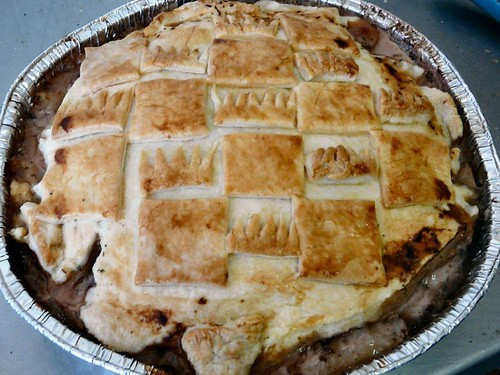
Medieval cookery - duck pies

This recipe for duck pie has few ingredients and may seem a little odd, using the juice but not flesh of onions as a seasoning. These were so good that back in the kitchens we spent quite a while trying to figure out an excuse not to send them out to be eaten at all... we wanted to keep them all for ourselves!

The hardest thing about the recipe is tracking down Verjuice. Verjuice is unfermented wine grape juice and is a common ingredient used in medieval and renaissance cooking. It has come back into modern cookery quite recently and adds a very special taste to dishes. In Australia, Maggie Beer produces verjuice commercially - sadly I have yet to find a supplier here in Europe.

At a total pinch you could use a very mild vinegar - I had a bottle of verjuice that a friend sent me and with experimentation, I made up a mixture of grape juice and wine vinegar and was able to get something that resembled verjuice for the feast, as my little bottle certainly didn't contain enough to feed 138 people!

Somewhat unusually for an ancient 'receipt', this recipe does have some guidance as to quantities of ingredients. My version used this as a guide but I made it with duck meat rather than a whole bird.

To bake a Mallard (The Good Housewife's Jewell 1596)

Take three or foure Onyons, and stampe them in a morter, then straine them with a saucer full of vergice, then take your mallard and put him into the iuyce of the sayde onyons, and season him with pepper, and salte, cloves and mace, then put your Mallard into the coffin with the saide juyce of the onyons, and a good quantity of Winter-savorye, a little tyme, and perselye chopped small, and sweete Butter, so close it up and bake it.

Take three onions and food process them. Pour 1/3 of a cup of verjuice into the food processor, then strain through muslin to extract the juices (I recommend setting aside the onions to make into onion soup). Take 1/2 a kilo of duck meat, chopped into pieces and marinate in the onion juice, with pepper, salt, 1/4 tsp ground mace and a pinch of ground cloves. I couldn't find fresh winter savory, so used dried - about 1/2 a tablespoon, then a teaspoon of thyme and a tablespoon of parsley.

Bake in a closed pie shell, or as little individual pies. Eat while piping hot.

Tuesday, 23 September 2008

A compound Salad

A few months ago I helped cater a renaissance feast for 138 people. I have realised that I have neglected to share with you my recipes! How terrible am I?

People often ask me, when I tell them that I cook medieval and renaissance food "what did people eat apart from big joints of roasted meat?". Well, here is a wickedly lavish salad that proves that there was SO much more to the renaissance palate than lumps of flesh!

Compound Sallet [The English Hous-wife, 1615]:

To compound an excellet Sallet, and which indeed is usuall at great Feasts, and upon Princes Tables, take a good quantity of blancht Almonds, and with your shredding knife cut them grossly. Then take as many Raisins of the Sun clean washt, and the stones pickt out, as many Figs shred like the Almonds, as many Capers, twice so many Olives,and as many Currants as of all the rest, clean washt, a good handfull of the small tender leaves of red Sage and Spinage: mixe all these well together with good store of Sugar, and lay them in the bottom of a great dish. Then put unto them Vineger and Oyl, and scrape more Suger over all: then take Oranges and Lemmons, and paring away the outward pilles cut them into thinne slices.Then with those slices cover the Sallet all over. Then over those Red leaves lay other course of old Olives, and the slices of well pickled Cucumbers, together with the very inward heart of Cabbage lettice cut into slices. Then adorn the sides of the dish, and the top of the Sallet with more slices of Lemons and Oranges, and so serve it up.

An actual recipe with quantities isn't really necessary with this dish; as you can see, it is basically a great mixture of different ingredients.

  • Almonds
  • Sultanas (raisins)
  • Figs
  • Capers
  • Olives
  • Red Sage
  • Currants
  • Baby Spinach leaves
  • Pickled cucumbers
  • Sugar
  • Vinegar
  • Oil
  • Cabbage
  • Lemon and Orange slices (for my salad I actually used pickled lemon slices)
I wonder if this salad counts as a recovered recipe? Recovered Recipes is hosting a fun foodcomp, challenging people to scan in an old recipe card and make the dish. This certainly is an old recipe eh?

Monday, 8 September 2008

Eating with the Vikings

One of the more fun mini-chain restaurants in Finland is Restaurant Harald. The one we went to was in Turku. Decorated up on a Viking theme, the waitresses wear Viking gear, and you can order dishes served up on shields or spitted on swords. Terry and I thought it might be fun to go to the one we saw in Tampere, but had our dinner in the tower instead, so when we got to Turku and found another "Harald", we couldn't resist!

The buffet table, or is it the bar?

For entree, I was seduced by the idea of moose salami, lingonberries and sprucetip syrup, so my choice was:

Game delicacies of Finland
Smoked reindeer sausage, delicious moose salami, grilled beef breast, smoked
garlic, red onion marmalade, lingonberries with spruce tip syrup, smoked almonds,
Rieska (soft flatbread), carrot bread, all served on a slab of slate.

My dinner partner didn't want an entree, but I knew he would 'throw himself on the grenade' and eat some of mine, and indeed he did.

Then for the main course I chose:

Sausage Pan
Wild boar sausage, reindeer sausage, pheasant meatballs, mustard seed sauce,
smoky cheese potatoes, creamed beetroot.

A hearty dish, this was probably a poor choice for me, as it was far more than I could possibly eat, but I really was in the mood for a sausage, and so even just having a mouthful of each was a pleasure. Terry helped out again as he still had room after his:

Blacksmiths Wild Duck
Wild duck breast, malt sauce, smoky cheese potatoes, marinated beans,
creamed beetroot, port wine marinated nuts, red onion marmalade.

I had a teeny taste of the duck which was pleasant, though not amazing by any means.

At this point in time, I was feeling pretty full, but Terry was rather keen on the idea of dessert, and we decided we really had to have something served on a shield... how could we possibly resist this indulgent platter?

Asgot the Red's Ending Shield
Caramel chocolate ice cream, chocolate cake, apple sorbet, Viking style pancakes,
Hulda’s berry dessert, blackberry compote, port wine marinated nuts,
carrot compote.

The caramel icecream was great as was the apple sorbet. The viking pancake was pretty ordinary but much better with the berries on top, and the chocolate cake was absolutely fantastic and although I was groaningly full I wouldn't let Terry have a crumb of my share!

I thought that Restaurant Harald was fun: the atmosphere and silly stories on the menus are very amusing, and if you are in Turku, Tampere or Kuopio, go on... try it... definitely worth 1 visit.

The entry to Harald

Monday, 30 June 2008

Fine cakes

Here is a truly old recipe from "The Good Husewife's Jewell" published in 1596:

Take fine flowre and good Damaske water you must have no other liqueur but that, then take sweet butter, two or three yolkes of egges and a good quantity of Suger, and a few cloves, and mace, as your Cookes mouth shall serve him, and a lyttle saffron, and a little Gods good about a sponfull if you put in too much they shall arise, cutte them in squares lyke unto trenchers, and pricke them well, and let your oven be well swept and lay them uppon papers and so set them into the oven. Do not burne them if they be three or foure days old they bee the better.


My redaction:
  • 2 cups flour
  • 175g butter
  • 3 egg yolks
  • 1 cup sugar
  • 1tsp saffron, ground
  • ½ tsp cloves
  • 2 tsp mace, ground
  • 3 tablespoons rosewater
  • 1 tsp baking powder
Mix dry ingredients, and rub in the butter to make something resembling fine breadcrumbs. Add the egg yolks and rosewater, and mix to make a dough. Wrap in plastic wrap and keep in the fridge for an hour or so to settle. Roll out to 5mm and cut out shapes. Bake for about 20 minutes at 175 degrees until lightly golden.

Saturday, 10 November 2007

ANZAC biscuits - step by step

Let me quickly start by saying to my American readers that ANZAC biscuits are NO relation to the scones that you call biscuits. They are, to you, cookies. I have always wondered what strange twist took place in the universe to have scones renamed biscuits and biscuits renamed cookies in the US. Anyone out there have a clue?

Anyway, I have gotten diverted from my goal, which was to introduce you all to an Australian (and New Zealand) speciality, the ANZAC biscuit. This crisp edged, chewy centred delight has to be experienced to be believed. Unbelievably addictive, I recommend making a double batch of these so that you can give 1 batch away but still have a batch to munch on.

The history of the ANZAC biscuit is sadly not a peaceful one. Named after the Australian and New Zealand Army Corp, these biscuits were made by the wives of soldiers, who sent them to their men. The lack of eggs and milk in the recipe means that these biscuits stay fresh for ages and could be sent through the mail to the men in the trenches.

Whatever the history, I am glad that these exist. Today I will share with you the step by step recipe of how to make them.

Ingredients
  • 1 cup plain flour
  • 1 cup rolled oats (regular oatmeal) uncooked
  • 1 cup desiccated coconut
  • 1 cup brown sugar
  • 1/2 cup butter
  • 2 tbsp golden syrup (or honey)
  • 1 tsp bicarbonate of soda
  • 2 tbsp boiling water

Combine flour, oats, coconut and brown sugar in a bowl.


In a small saucepan, melt the butter and golden syrup

Boil some water, and put two tablespoons of water in a cup. Gently stir in the bicarb soda. Once the bicarb is dissolved, pour into the saucepan of melted butter and golden syrup and give it a gentle stir to combine. The mixture will foam up into a froth.

Pour into the dry ingredients:


and stir until well combined:
Put tablespoons of the mixture on to a baking tray (I use silicone paper underneath). Make sure you leave room for the mix to spread. You can roll balls of mix and press down with a spoon for more perfect looking biscuits.


Bake in a moderate oven (180degrees C/350 F) for 15 minutes, until the biscuits start going golden around the edges (if you like your biscuits completely crisp allow to brown lightly all over). Remember that the biscuits will continue to cook after they come out of the oven! Allow to cool for a while on the tray until the biscuits set enough to move, then move to a wire rack to cool.

Enjoy!

Tuesday, 23 October 2007

Musee de les arts culinaire

While driving around on the weekend, I stumbled across a sign pointing to the Musee de les arts culinaire in a village called Villeneuve Loubet. Now that was something guaranteed to grab my attention and I just had to return the next day to take a look.

Unfortunately the museum was not all I had hoped - no items older than 200 years, but there were still some interesting odds and ends to be seen. Villeneuve Loubet was the home of Escoffier, and this museum was put together to honour his life and achievements in the culinary arts. Escoffier, by the way, was a superstar chef in the late 19th and early 20th century. Inventor of the Peach Melba, he pretty much transformed cookery in Europe - in fact he is credited with being responsible for food being served in courses, rather than all simultaneously - a pretty big change for the world of food. Escoffier published the book 'Le Guide Culinaire' which is still a bit of a bible for cooks.

Items of interest to me in the museum were a 19th C noodle-machine, some rather spekky skewers, and various of the menus from places like Maxims in Paris.

Thursday, 11 October 2007

A visit to a medieval kitchen

On the weekend I had the pleasure of visiting Hampton court and getting to meet and chat to the authors of the foodblog "Cooking the Books". The kitchen was in full swing as the people chopped, sliced, diced and baked their lunch; happily taking the time to chat to everyone about what they were doing.

My friend Steve and I chatted with one of the cooks (Robert) and discussed our respective favourite renaissance cooking resources. I didn't get a chance to talk about the crustade with Richard (a recipe that he was working on and that I had some different perspectives on).

I am so jealous that these guys get paid to do what they do... spend their days experimenting and researching renaissance recipes. What colour is green?
We also talked cooking pots and cauldrons, and Robert proved to be very knowledgeable indeed about them. Steve has a serious case of lust after these ones:

So if you see anything like them for sale in a second hand shop, snaffle me one eh?