Showing posts with label recipe. Show all posts

Tuesday, 25 September 2012

Deepest Darkest Chocolate Fudge biscuits

Ok, I am about to share with you one of my most precious recipes. These amazingly rich, tasty and chewy biscuits (cookies for my US friends, so don't go thinking this is a scone recipe!) are seriously unbelievably good.  The recipe was given to me by my friend Jocelyn, for which I will thank her forever.

It is a rare recipe that uses this much chocolate without being too sweet. Cocoa, melted chocolate, chocolate chips, this recipe has it all, and the final result is truly special. 


One of the fun things too about this recipe is sharing the list of ingredients with friends... making a double batch particularly so, because then you can tell them that it contains 1.3 KILOS of chocolate chips. 

I think that one of the keys to this recipe is beating the butter and sugar by hand... I don't know why it is, but I do it by hand, and my version seems to come out better than those made by friends using a mixer. Proof that there are times in life, where it is best to do things the slow way.  If you are going to use a mixer, I advise beating on a slow speed.

Deepest Darkest Chocolate Fudge Biscuits (cookies)

214g plain flour
56g cocoa
1 tsp bicarbonate of soda
a pinch of salt
227g milk chocolate broken into pieces
113g unsweetened chocolate broken up (a nice dark bittersweet will do)
340g soft light brown sugar
170g unsalted butter (take out of the fridge to soften)
3 eggs
1 tsp vanilla essence
OPTIONAL - 680g plain chocolate chips. 

Method

Sift flour, cocoa, bicarb and salt. Set aside.
Put plain and unsweetened chocolate pieces into a double boiler and heat for 12 - 15 minutes. Stir till smooth and keep at room temperature until needed. (You can microwave the chocolate instead, but be very careful not to over cook it)
Beat butter and sugar. Once creamed, add eggs, one at a time, beating into to the mixture. Add vanilla essence and beat. Add chocolate and beat. Add flour mixture and chocolate chips stirring until thoroughly combined.
For lovely big giant cookies, drop a tablespoon of mix per biscuit onto baking sheets (about 6-8 biscuits per sheet).   For more normal sized biscuits, a heaped teaspoon is about right. 
Bake on the top and middle rack of the oven at 170ºC for 15 minutes, rotating half way through baking time. Do keep an eye on the time, as the high sugar content means that they can burn very easily. 
 
Cool on sheets for 5-6 minutes. Transfer to cooling rack. 

Sit back and enjoy one of the most sensational sweet experiences of your life.

Saturday, 22 May 2010

Party food - traditional sausage rolls

I have another catering gig - my friend Oggy's wedding. I gave the bride and groom a list of potential dishes, from which they could choose a menu. They asked what the chances were of having every one of them, as they liked the sound of all of them so much! But the groom also had his own special request: sausage rolls.

I have posted up a sausage roll recipe previously: my chicken, basil and prosciutto sausage rolls. Various friends having made them have declared them to be a great success. That said, these are not going to fulfill the desire of the groom: I think he wants a good red meat sausage roll. So a bit of experimentation has produced this recipe, which I think will fit the bill perfectly. It makes 100 cocktail sized sausage rolls. I know that this sounds like a lot, but believe me, they disappear quickly during a party!

You do need a food processor for this recipe, and it is super quick and easy. Be warned though, there is no way to avoid getting your hands messy!

1.3kg beef mince
2 medium eggs
2 large onions
2 1/2 cups fresh white breadcrumbs - use the food processor to process stale 'square' bread.
4tsp dried herbs - I used sage, oregano, basil and marjoram
1 tsp freshly ground pepper
1/2 tsp salt
1.5 kg pre-rolled puff pastry (5 rolls)
1 egg lightly beaten, for brushing on top of the rolls

Peel and roughly chop the onion. Pop it into the food processor and process until it is quite fine in texture (but not liquid!). Put into a large bowl with the breadcrumbs. Stir in the herbs, salt and pepper.

There is no need to rinse the bowl of the food processor. Just put in the mince (you might need to process in two lots) and process it down to make it a sort of paste. It doesn't need to be perfectly smooth, but it does need to be much finer than the original mince. This will help the filling to hold together. Put into the bowl, and break into the bowl, two of the eggs. With your hands, mix the whole lot together.

Cut the sheet of puff pastry in half lengthwise. Take a good handful of the filling and form into a fat sausage (I guess about 2.5 cm/1 inch in diameter) and lay along the long edge of one piece of the pastry. Brush the opposite edge with water and then fold the pastry over to make a roll. Place seam side down. Repeat with the other pieces of pastry.

Cut the rolls in 3cm lengths. Brush the tops with egg yolk, and chill for at least 15 minutes. Bake for about 15 minutes until golden brown in quite a hot oven - 240 degrees. Serve warm with tomato sauce, home made or otherwise. (These can happily be made the day before, or even made and frozen uncooked)

Friday, 7 May 2010

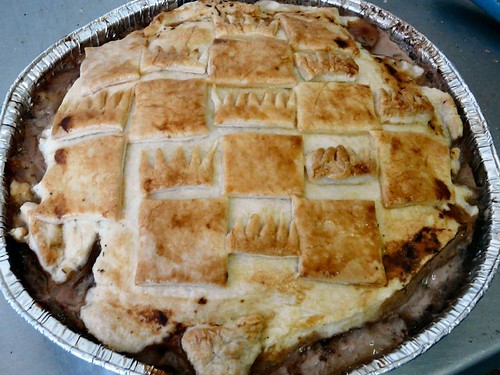
Medieval cookery - duck pies

This recipe for duck pie has few ingredients and may seem a little odd, using the juice but not flesh of onions as a seasoning. These were so good that back in the kitchens we spent quite a while trying to figure out an excuse not to send them out to be eaten at all... we wanted to keep them all for ourselves!

The hardest thing about the recipe is tracking down Verjuice. Verjuice is unfermented wine grape juice and is a common ingredient used in medieval and renaissance cooking. It has come back into modern cookery quite recently and adds a very special taste to dishes. In Australia, Maggie Beer produces verjuice commercially - sadly I have yet to find a supplier here in Europe.

At a total pinch you could use a very mild vinegar - I had a bottle of verjuice that a friend sent me and with experimentation, I made up a mixture of grape juice and wine vinegar and was able to get something that resembled verjuice for the feast, as my little bottle certainly didn't contain enough to feed 138 people!

Somewhat unusually for an ancient 'receipt', this recipe does have some guidance as to quantities of ingredients. My version used this as a guide but I made it with duck meat rather than a whole bird.

To bake a Mallard (The Good Housewife's Jewell 1596)

Take three or foure Onyons, and stampe them in a morter, then straine them with a saucer full of vergice, then take your mallard and put him into the iuyce of the sayde onyons, and season him with pepper, and salte, cloves and mace, then put your Mallard into the coffin with the saide juyce of the onyons, and a good quantity of Winter-savorye, a little tyme, and perselye chopped small, and sweete Butter, so close it up and bake it.

Take three onions and food process them. Pour 1/3 of a cup of verjuice into the food processor, then strain through muslin to extract the juices (I recommend setting aside the onions to make into onion soup). Take 1/2 a kilo of duck meat, chopped into pieces and marinate in the onion juice, with pepper, salt, 1/4 tsp ground mace and a pinch of ground cloves. I couldn't find fresh winter savory, so used dried - about 1/2 a tablespoon, then a teaspoon of thyme and a tablespoon of parsley.

Bake in a closed pie shell, or as little individual pies. Eat while piping hot.


Wednesday, 16 December 2009

Dark chocolate tartlets

Photo by Ed.
I served these tiny tarts at the wedding I catered for my friends Patrizia and Ed. (Full menu here). They were a real hit - rich and creamy and just the right size for a not-quite-guilt-free mouthful. 

Ingredients


320g dark chocolate, (at least 60% cocoa but I actually don't recommend more than 80%) 
500ml cream 
4 egg yolks 
2 whole eggs 
1/4 cup sugar 
gold leaf to decorate 

Method

 Combine chopped bittersweet chocolate and cream in a heavy saucepan. Whisk over low heat until chocolate is melted and smooth. Remove saucepan from heat and allow to cool a little.

In a separate bowl, whisk the egg yolks, egg & sugar. Very gradually whisk chocolate mixture into the egg mixture until smooth and blended.

Pour chocolate filling into crust, sprinkle with gold leaf, and bake at 180 degrees until set (about 15-20 minutes for a single large shell, or 5-10 for small shells).

Saturday, 21 March 2009

Cinnamon & apple cookies

With the delicious combination of oats, brown sugar, apples and cinnamon, these biscuits are like an apple crumble in biscuit form. This recipe isn't mine, but is adjusted from the ever reliable Australian Women's Weekly. Remember if you are cooking from this blog, my recipes are metric! 
2 eggs 
1 1/2 cups brown sugar (275g) 
1 teaspoon vanilla essence 
1/2 cup mild vegetable oil 
2 tblspn golden syrup 
2 cups rolled oats 
1 1/2 cups chopped dried apples (135g) 
1 3/4 cup plain flour (150g) 
3/4 tsp baking powder 
1/2 tsp bi-carb soda 
1 tspn ground cinnamon 

Set your oven to preheat at 210 degrees. Beat the sugar and eggs with an electric mixer until the mix becomes light in colour. Stir in the vanilla essence, oil and golden syrup. Then stir in the oats, apple and sifted dry ingredients. 

Cover and refrigerate for an hour. 

Roll tablespoons of the mix into balls, and press down onto a silicone-paper lined baking tray. Bake for 10 minutes or until lightly browned. Cool on the tray.

Sunday, 22 February 2009

Clementine Cookies

I had a fit of baking last night: we are doing some fundraising at work for the Australian bushfire appeals. I did a giant batch of anzac bikkies. I finished the anzacs at about 2am but by then the baking bug had bit me and I found myself searching through my cupboards for ingredients to make something, anything more! My eyes fell upon the net of clementines in the big fridge (ie, on the balcony, which during winter becomes my second fridge). Grand. I would make something from them. Grand. umm... what?? From this 2am dilemma sprang this invention: 

Clementine Cookies 

 2 dessert spoons of finely grated clementine rind 
2 egg yolks
125 g butter 
1 cup caster sugar 
2 tablespoons clementine juice 
2 and a half cups self raising flour 

Turn your oven onto moderate (approx 170 degrees C) to warm up. Beat the egg yolk, butter, rind and sugar until fluffy. Add the flour and then drizzle in the juice until it comes together into a dough. 

Knead gently on a lightly floured surface until the dough is smooth. Take dessertspoons of the mixture and roll into balls. Press onto baking trays that are either lightly greased or have silicon paper. 

Bake for 15 minutes until lightly browned and allow to cool on the tray. Once cool ice and decorate - make up an icing with clementine juice and icing sugar. 

This recipe makes about 60 biscuits.

Tuesday, 30 December 2008

First experimentation with the new pasta machine - Foie Gras Ravioli with Pumpkin Veloute

Foie gras is a very traditional thing to eat at Christmas time in France and (at least southern) Switzerland. 

Last year I made tiny little foie gras and red onion tartlets (which I completely failed to photograph, how bad am I?) and this year I thought I would put my new pasta making machine to work and make foie gras ravioli. 

I started with a basic egg pasta dough: 
300g fine white flour 
3 eggs 

Place the flour in a heap on the work bench, and make a well in the centre. Break the eggs into the centre and then using your fingertips work the flour into the eggs. This is the really fun messy bit. Once incorporated, knead the dough, if necessary adding just a drop of water or two to get a good workable consistency. How long to knead? Till the dough stops feeling sort of grainy and starts feeling smooth.

Wrap up in plastic wrap and let sit for at least half an hour. Break the dough into two pieces (leaving one wrapped up) and set your pasta machine to the widest aperture. flatten the ball of dough out a bit so it can fit through and feed it through by cranking the handle on the machine. Once fed through, fold it in half and feed it through again. If the dough kind of catches on the rollers and has a rough knobbly surface, smooth just a little flour on to the dough before folding and feed through again. Do this 6 or 7 times... I promise you will know when it is done as your pasta dough will be smooth and silky. 

Then take the machine in a step and feed the pasta through again. In another notch and feed again... You might find you now have an unmanageably large length of dough; if so, cut it in half and put one half under a damp clean dishcloth while you deal with the other half. Keep taking the machine in a notch and feeding the pasta through until you have the finest sheet you can get. Don't worry if the edges are not perfect! 

Stage 2: the Ravioli 
1 bloc du foie gras (about 200g) 
1 batch egg pasta dough 

If you are making square or triangular ravioli you can simply place the sheet on the bench, brush it with water, put your ingredients on top, lay another sheet on top of that, and then press together and cut out the ravioli. In my case I wanted to make something a little more festive, so I cut out heart shapes. Then I (and my handsome assistant) brushed the edges of one heart with water and then placed pieces of bloc du foie gras on the pastry, leaving a good edge of pastry. We then placed another heart of pasta on top and pinched around the edges firmly. Sprinkle the hearts with flour to stop them sticking together then spread out on a tray and pop them in the freezer. Once frozen you can put them into a ziplock bag and keep them that way until ready to use. 

Stage 3: Pumpkin Veloute 
1 medium onion, finely diced 
1 butternut pumpkin (aka squash) 
1 tsp caster sugar drizzle of olive oil 
1 litre of chicken stock. 

In a large pan, soften the onion in the oil until translucent. Add the cubed pumpkin and sprinkle with the caster sugar. Stir the cubed pumpkin over medium heat until the pumpkin is browned and the sugar has caramelised. Pour over the chicken stock and raise the heat to bring to the boil. Simmer until the pumpkin has cooked completely then put through a ricer, after which you can use a stick blender to blend to a velvety smooth veloute. 

To complete the dish: Heat the veloute until warmed. 
Bring a large pot of water to the boil. Once it has reached boiling point, add the ravioli (still frozen). 

Cook for just a few minutes till al dente. Put out serving plates, add some of the veloute and then lay the ravioli on top in a decorative fashion. 

Grate a little nutmeg on top.
Photo courtesy of Ed.

Wednesday, 10 December 2008

Beef in Beer

On my weekend jaunt across the border I bought myself some beef. I had the idea that I would make beef bourguignon from my new recipe book "The Complete Robuchon". Nice simple meal, beef, burgundy, onions. Nope. 19 ingredients (mind you that is including spices). Cooking time, 2 and a half hours plus 25 minutes for the onions, 5 minutes for the lardons and 10 minutes for the mushrooms. 5 pots or pans. 5!!!! As we say in Australia "bugger that for a game of soldiers". 

Beef in beer instead. 7 ingredients. 1 frypan, 1 crockpot - much better! 

900g diced beef 
3 medium sized onions, sliced 
3 large carrots chopped up 
500g new potatoes (cut larger ones in half) 
Olive oil 
2 large cans of beer (or one bottle) 
2 beef stock cubes 

Chop the carrots and cut in half the bigger of the potatoes. Put in the crock pot/casserole. Heat up a fry pan with a little oil, and brown the meat in batches and add to the crock pot. 

Cook the sliced onions in the pan till softened and a little browned. Pour some of the beer into the pan to lift the delicious browned bits from the pan. Pour into the crockpot and add the rest of the beer and the stock cubes. 

If using an electric crock pot, cook for 7 hours on low. If using a pot on the stove, simmer gently for 2 hours. How easy is that? Ok so it takes a while to cook, but effort? Almost zero and the taste... delish!

Wednesday, 29 October 2008

Lemon iced biscuits

I made a batch of these pretty iced biscuits as a birthday gift for a dear friend. They were sweet, delicious and incredibly cute. 
200g butter 
1 tsp vanilla paste 
1 egg 
1 1/2 cups of plain flour 
1 cup caster sugar 
1/2 cup self raising flour 

Method 1. Put all the ingredients into your food processor. Pulse until combined. Wrap ball of dough in plastic wrap and put in the fridge to rest for an hour. 

Method 2. Beat butter, sugar, vanilla and egg until pale. Gradually add the flour until combined. Wrap in plastic wrap and put in fridge to rest for half an hour. Roll out to 5mm and cut out circles. 

Because this recipe has a raising agent in it, it isn't really suitable for shaped biscuits. 

 Another easy option is to form the dough into cylinders and roll in plastic wrap,twisting the ends. Cool for an hour and a half, remove from the oven and then slice to make rounds. 

 Bake in a moderate oven for about 10 minutes. Cool for 5 minutes on the tray and then move to wire racks. Ice with lemon icing (add lemon juice drop by drop to icing sugar until you have a spreadable paste). Sprinkle with decorations while the icing is still wet.

Thursday, 9 October 2008

Impromptu fig conserve

With figs in season as they are, I just had to buy some more didn't I? I had this idea in mind for tomorrow night's dinner, but tonight, the figs were looking a bit peaky... not to be left for tomorrow night. Hmmm... what do I do with them then? I know, I will make jam!

The challenge is that I only had 6 figs, not the kilo or so that most recipes seem to demand. So I just had to invent something, and here it is.

6 figs
1 cup jam sugar*
1/2 cup grand marnier
1 star anise
1 tsp lemon juice

In a small saucepan, combine the chopped figs, jelly sugar, lemon juice and grand marnier. Sit for an hour to soak.

Start the stove and bring the mixture to a gentle bubble. Add the star anise. Cook for 15 minutes stirring regularly. Remove the star anise and then continue to cook for another 15-20 minutes, stirring regularly, and crushing with a potato masher, to break up the bigger pieces. Once thickened to "soft ball" stage, pour into sterilised glass jar. Makes 1 x 500g jar of jam.

*jam sugar is a sugar which includes pectin

The figs starting to break down into delicious jam..

Wednesday, 1 October 2008

Sweet potato, pumpkin & feta pizza

Long gone are the days of pizza having to have tomatoes and mozzarella. Nowadays you can get pretty much anything on a pizza, for example, tandoori chicken & thai green curry. You can even buy strange dessert pizzas. I am all for pushing the envelope in cooking, so I am pretty open minded about what should or should not go on a pizza. That said, there are some things that should simply not go there... along with deep fried mars bar and deep fried cupcakes, and I am thinking that rocky road pizzas are one of those things.

But this delicious pizza is all good. The combination of the sweetness of the pumpkin and sweet potato and saltiness of feta create a perfect partnership joined with the textural joys of the softness of the vegetables and crispness of the crust. 

1 small sweet potato (around 200g) 
1 wedge of pumpkin (around 200g) 
1 onion 
50g feta 
pizza dough 

Preheat your oven to 200 degrees C. Peel and dice the pumpkin, sweet potato and onion. Pan fry with a little olive oil on a relatively low heat until the onion has gone transparent and the vegetables have softened. 

Spread the mixture onto the pizza dough and crumble feta on top. Bake for 20 minutes until the crust has crisped and the cheese has browned.

Thursday, 25 September 2008

Marmalade Cupcakes

There is a bit of a tale to this recipe. A friend of mine broke her leg. Her mum, being the caring sharing type, decided she couldn't stay in Australia with her daughter suffering a broken leg in Switzerland, so she flew across.

And what does a worrying mum do with herself during the day when her daughter is stuck on the couch? She makes marmalade of course! So how does this connect to me and marmalade cupcakes? Well my friend moved back to Australia and kindly donated to me the unused contents of her cupboards - including a lovely jar of marmalade.

Inspired to bake one day, I created these delicious cupcakes; only wish my friend was here to try one.
  • 125 butter
  • 1 cup caster sugar
  • 2 cups of flour
  • 1/2 teaspoon bicarb soda
  • 1/2 teaspoon baking powder
  • pinch of salt
  • 1/2 cup milk
  • 3 eggs
  • 1 cup orange marmalade
Preheat the oven to 180 degrees. If, unlike me, you have a muffin tin, put the paper cases into it, otherwise, just lay them out on a tray.

In your mixer, beat the butter and caster sugar until light fluffy. One by one, add the eggs, beating well between additions. While the mixer is still going, add the marmalade.

In another bowl, combine the flour, bicarb, salt and baking powder.

Now, alternating between the milk and the flour mixture, add to the mixer, until combined (but don't overbeat).

Fill the paper cups with the mixture and then bake for around 20 minutes until risen and golden.

The special joy of these cupcakes is that the marmalade makes little pockets of marmalade toffee, which are just delicious. I topped them with a simple icing made of marmalade, icing sugar and cream cheese but actually I loved them just as they were. I took them to work and they were inhaled with gusto.

This recipe made about 2 dozen cupcakes

Tuesday, 23 September 2008

A compound Salad

A few months ago I helped cater a renaissance feast for 138 people. I have realised that I have neglected to share with you my recipes! How terrible am I?

People often ask me, when I tell them that I cook medieval and renaissance food "what did people eat apart from big joints of roasted meat?". Well, here is a wickedly lavish salad that proves that there was SO much more to the renaissance palate than lumps of flesh!

Compound Sallet [The English Hous-wife, 1615]:

To compound an excellet Sallet, and which indeed is usuall at great Feasts, and upon Princes Tables, take a good quantity of blancht Almonds, and with your shredding knife cut them grossly. Then take as many Raisins of the Sun clean washt, and the stones pickt out, as many Figs shred like the Almonds, as many Capers, twice so many Olives,and as many Currants as of all the rest, clean washt, a good handfull of the small tender leaves of red Sage and Spinage: mixe all these well together with good store of Sugar, and lay them in the bottom of a great dish. Then put unto them Vineger and Oyl, and scrape more Suger over all: then take Oranges and Lemmons, and paring away the outward pilles cut them into thinne slices.Then with those slices cover the Sallet all over. Then over those Red leaves lay other course of old Olives, and the slices of well pickled Cucumbers, together with the very inward heart of Cabbage lettice cut into slices. Then adorn the sides of the dish, and the top of the Sallet with more slices of Lemons and Oranges, and so serve it up.

An actual recipe with quantities isn't really necessary with this dish; as you can see, it is basically a great mixture of different ingredients.

  • Almonds
  • Sultanas (raisins)
  • Figs
  • Capers
  • Olives
  • Red Sage
  • Currants
  • Baby Spinach leaves
  • Pickled cucumbers
  • Sugar
  • Vinegar
  • Oil
  • Cabbage
  • Lemon and Orange slices (for my salad I actually used pickled lemon slices)
I wonder if this salad counts as a recovered recipe? Recovered Recipes is hosting a fun foodcomp, challenging people to scan in an old recipe card and make the dish. This certainly is an old recipe eh?

Thursday, 18 September 2008

Morroccan lamb tartlets

This delicious canape is again quite simple (but then again, ultimately most cooking is!) and all of the parts can be prepared in the days before your event, allowing you to simply assemble on the night.

There are three parts to this recipe
  1. Cases
  2. Lamb
  3. Hommous
1. Let's start with the cases. Buy a loaf of sliced white bread. Lay slices out on a board, and roll them with a rolling pin to flatten them. Using a cookie cutter (in this case I used a star), cut out shapes from the bread. A cookie cutter that will allow you to get four pieces out of one slice of bread will make bite sized canapes. Brush the shapes with melted butter, and push into the holes of mini muffin tins. Bake at 180 degrees until crisp and golden.

Cool and keep in an airtight container - these will easily keep for up to 4 days (and actually as I write I am munching on a few left over cases that are now a week old and still crisp and yummy).

2. Time for the Lamb.

I rubbed lamb fillets with Ras el Hanout (A north African spice mixture containing all sorts of things, but typically cardamon, cloves, cinnamon, chili, cumin, coriander, pepper and turmeric) and put them in a container in the fridge overnight in the fridge to marinate. The next day I pan fried the lamb fillet - you want the lamb to be nicely browned on the outside but still slightly pink and juicy on the inside. As you cook it, you can feel when you press on it, the meat getting firmer as it cooks.

Once cool, wrap in plastic wrap and refrigerate. Leave as whole fillets until you are just about to assemble the canape.

3. Hommous

Do have a try at making your own hommous - Rosa at Rosa's Yummy Yums has a great recipe or you can buy some but make sure it is a good quality fresh hommous.

So now you have all three parts, its time to serve these up! Slice the lamb fillet very thinly on the diagonal. Pipe or spoon some hommous into the bread cup and arrange a slice of lamb on top, and perhaps garnish with a little fresh coriander. Simple, and totally delicious!

Tuesday, 16 September 2008

Dinner for one... figs three ways

Tonight is the least glamorous night of the month for me: my fortnightly access to the laundry in the basement. A night of tedium waiting for one load to finish before loading up the next. The plus is that it is a night that I get to spend at home alone, in my own space, which always inspires me to cook! As my dear friend Cate calls it, it's "darling self" time.

A quick meander around the shop brought me my inspiration for the night. It's the season of figs... those gorgeous plump purple fruits with their sensuous gem-toned flesh. There is something incredibly sexy about the look, the texture and the taste of this glorious fruit. I decided to spoil myself for dinner alone tonight... figs three ways.

Firstly, a whole fig split and roasted slowly until tender and juicy, then gorgonzola tucked into it, going soft and melding with the sweet juices of the fruit. Drizzled with honey or just as it is... fabulous.

Melted and soft to be picked up and eaten with the fingers, just to give an excuse to lick the lush nectar up.. or spread over bread still warm from the oven.

Second, cut up into chunky jewells and wrapped in jambon cru and slow roasted until the jambon starts to crisp up and a glorious mingling of ham and fig juice dribbles out from underneath. Served with a balsamic vinegar reduction, this is simply irresistable.

I baked these on a silicone sheet, and between you and I, when the liqueur cooled, I licked it all up!

Then finally time for dessert... Simple and sweet... a fig sliced in quarters, cooked with port and honey and served with a dollop of creamy rich greek yoghurt.

Utterly content with dinner alone.

Wednesday, 3 September 2008

A little bit of silliness - deconstructed potato salad

I have canapes on my mind at the moment because next week I am catering a small cocktail reception for 40 people. Anyway, I had this thought about raclette potatoes. If you aren't familiar with raclette potatoes, they are golden, buttery and totally delicious. Boiled, they taste like they have been soaked in melted butter. They also keep their shape really well when cooked, which makes them lousy for irish stew but excellent for samosas and, I theorise, for cocktail food.

My thought was to do a sort of deconstructed potato salad... potatoes sliced skewered and layered with mustard mayonnaise. But this alone, while tasty, would be texturally dull as dishwater, and equally boring to the eye.

So what to do? How about a sliver of cucumber, to add some colour and texture... not bad, not bad at all.


Completely coincidentally, tonight's little invention fits into the Recipe Remix food challenge - to rethink a traditional summer "cookout" food. Now to be truthful I am not entirely sure what a cookout is (I am thinking it is what we Aussies call a "barbie") but potato salad is one of the dishes listed as a dish to be played with, so this becomes my little contribution to the fun!

Sunday, 31 August 2008

Savoury pullapart bread

I have been having a bit of a bread baking frenzy. It started after the fete de Geneve, when a friend gave me a big bag of rehydrated dried mushrooms. I couldn't use them all so I froze it in bags. I also made a batch of bread dough for a dinner, which completely failed to rise. I am a persistent sort of girl though, so I put the bread dough in the fridge, and the next morning, when I looked in the fridge there was risen dough! Hmmm... what to do with it? I took it to work and at morning tea time, used some of the mushroom mix to make a loaf of cheese and mushroom pull apart bread. My colleagues devoured it and that just got me started...

Next thing I know, I am making cinnamon scrolls, fruit bread, and today, bacon onion and cheese pull apart bread.

Pull apart bread is great fun both to make and eat. Kneading bread is always satisfying, as is seeing the wonderful dough double, and then the pleasure of forming the lovely savoury bites. The scent of baking bread fills my apartment and I am only surprised that my neighbours haven't been knocking on the door demanding a bite!

This recipe is pretty flexible and you can put whatever filling inspires you into the centre, sweet or savoury.

Pull apart bread

1 package instant yeast
2 tablespoons sugar
2 teaspoons salt
500g flour
1 cup warm milk
1 large egg
8 tablespoons melted butter or oil

Filling
1 onion finely chopped
150g bacon, finely chopped
200g cheese grated

Method 1
Combine the dry ingredients. In another bowl put all the liquid ingredients, egg, milk & oil. Add a cup of the dry ingredients and stir well. Gradually add the other dry ingredients until you get a soft dough. Knead on a lightly floured work surface for about 6 minutes until the dough is smooth and springy to the touch.

Method 2
Place dry ingredients in bowl of electric mixer (not food processor). Use the mixing blade and add the wet ingredients. Once combined, change to dough hooks and knead for 4-6 minutes, until the dough is smooth and springy to the touch.

Oil a large bowl. Put the dough into the bowl and then turn it over so that the surface is oiled. Cover with plastic wrap. Place somewhere warmish (funnily enough, beside my laptop seems to work well for me, so that the warm air from the fan circulates around it) for about an hour and a half until the dough doubles in size.

Fry the onion gently it starts going transparent, then add the bacon. Fry just for a minute. Allow to cool while you grate the cheese.

Once the dough has risen, deflate and then grab pinches of dough (about the size of a walnut. Form into a ball, then flatten it out into a disk. Put a little of the onion and bacon and grated cheese onto the centre of the disk and then pinch it closed to make a little ball. Layer into a lightly oiled loaf tin.

Allow to rise about 30 minutes. Preheat the oven to 200 degrees. Once the bread has risen, bake for about 30 minutes until the bread is a dark golden brown and when turned out of the tin the bottom of the loaf sound hollow when tapped.

Eat, ideally while still warm!

Friday, 1 August 2008

Smoked Trout Pate

While I wanted to cook lots of things for my foodie colleagues' departures, I was a bit limited in time... so I added this simple pate to the menu to provide a savoury alternative to the cakes on offer.

Smoked trout pate is wonderfully easy to make, and is a guaranteed winner at any party (or in this case work function). Best made the night before, so that the lovely smokey flavour of the trout can permeate the pate.

200g cream cheese
250g smoked trout fillets
2 tablespoons lemon juice
50g melted butter

Put all the ingredients in a food processor and pulse till well combined - but don't over blend, as you want to keep some texture.

Put into your serving dishes and cover with plastic wrap and keep in the fridge overnight. Serve with a small serving knife with toasts or baguette.

Tuesday, 29 July 2008

Vegan Coconut Cake

Two of my colleagues are leaving Geneva for the flatter climes of Australia. One of them is, like me, a foodie, so I just had to cook something for their farewell morning tea.

First up... a vegan cake. My friend James is a vegan and every time we have a morning or afternoon tea he is left holding his cup of coffee unable to eat any of the goodies. So I decided that this time around he would not be left cakeless. I wanted to make something that wasn't "typical" vegan food, all wholemeal flours soy and treacle, but something light, fluffy, properly cake-like. So I baked this very yummy coconut cake, only to get to work to discover that James is off this week on holidays. How frustrating! Still, my other colleagues wolfed it down so it was still a success story.

Coconut Cake


3 cups of self raising flour
2 cups caster sugar
1 c dessicated coconut
3/4 tsp salt
2 cups coconut milk
2/3rds of a cup of vegetable oil (something without a strong flavour)
1 tsp vanilla
2 tspns vinegar

Start by putting your oven on to heat up to 180 degrees. Grease and sprinkle a ring tin with flour (I in fact use baker's grease - recipe to come).

In a your mixer combine the flour, dessicated coconut, sugar and salt. Stir in the coconut milk and oil and mix until you get a smooth batter. Just before pouring into the cake tin, stir in the vinegar - this step seems to be the key to getting a lovely light cake with a soft texture and golden crust.

Bake around 1 hour 15 until a toothpick inserted into the centre comes away clean. Don't open the oven to test it until it has been in at least 25 minutes or it will sink! Cool briefly in the pan then turn onto a cooling rack. This cake is beautifully moist and needs no icing.

Wednesday, 16 July 2008

Simple indulgence - Vanilla Bean Icecream

This gloriously simple icecream can't be beaten. All the complicated fancy icecreams out there, the cookie cream confections and english toffees are just blown out of the water. Creamy, rich, pure... sublime.

4 egg yolks
100g caster sugar
1 cup milk
1 cup cream (double cream)
The seeds from 1 vanilla bean

Heat the milk just to the boiling point, remove from the heat. Beat the eggs and sugar together and while beating the milk continuously, add the egg mixture to the milk. Return to the stove and heat gently while stirring constantly until the mixture thickens and coats the back of a wooden spoon. Cool completely and stir in the cream and vanilla. Pour into your icecream machine and churn/freeze for 20-30 minutes.

Serve au naturale or with fresh fruit or a hot fruit tart - I made this icecream when a friend came over to dinner and served it with a nectarine tart that I invented on the spot.